SGF Reaffirms Support for Fiscal Responsibility Commission as Muruako Concludes Tenure
Oru Leonard
The Secretary to the Government of the Federation (SGF), George Akume, has reaffirmed the Federal Government’s continued strong support for the Fiscal Responsibility Commission (FRC), commending the Commission for its role in strengthening fiscal discipline and macroeconomic stability.
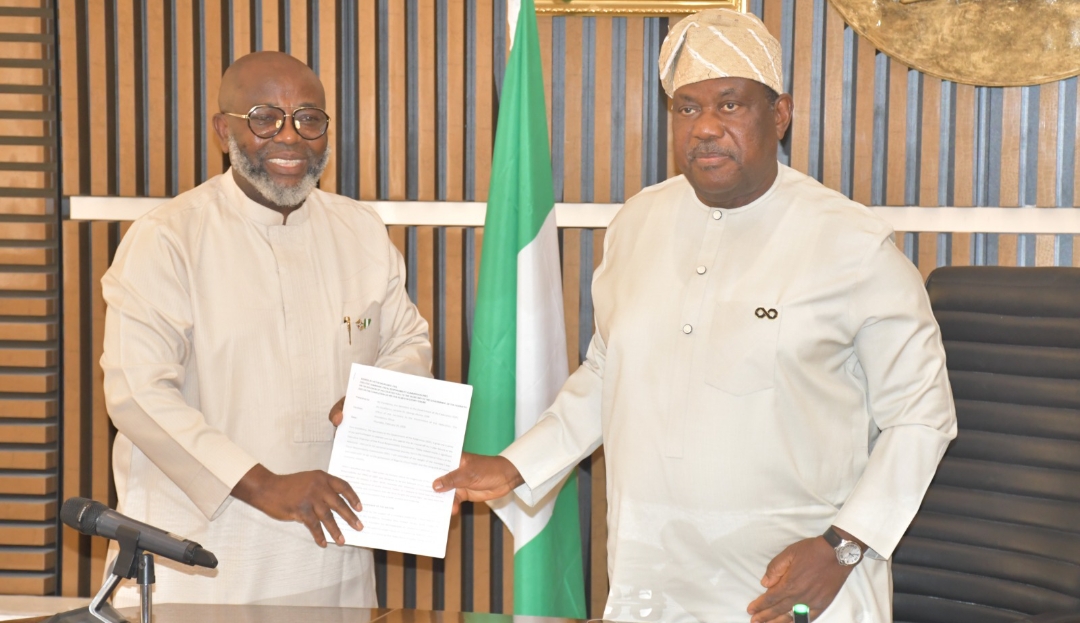
Akume gave the assurance on Thursday at his office in Abuja during a courtesy visit by the outgoing Executive Chairman of the FRC, Victor Muruako, whose five-year statutory tenure has come to an end.
Describing Muruako as “a very hardworking, result-oriented and productive leader,” the SGF lauded his contributions to deepening compliance with the Fiscal Responsibility Act. He noted that the Act has remained instrumental in promoting microeconomic stability and enhancing the credibility of Nigeria’s fiscal framework.
Akume emphasized the importance of the Medium-Term Expenditure Framework (MTEF), describing it as critical to safeguarding the nation’s fiscal image. He called on Ministries, Departments and Agencies (MDAs) to strictly adhere to the MTEF guidelines and ensure the timely preparation and submission of audited financial statements.
The SGF further commended the Commission’s sustained monitoring and enforcement efforts, which he said have laid a solid foundation for economic growth through improved fiscal transparency and accountability.
In his valedictory address, Muruako reflected on his stewardship of the Commission, describing his tenure as a period of institutional strengthening and strategic reform.
He expressed gratitude to President Bola Ahmed Tinubu for providing the political will necessary to implement reforms under the administration’s economic agenda. He also thanked the SGF for sustained administrative support, describing the Office of the SGF as a stabilizing force during challenging periods.
Muruako outlined key achievements of the Commission over the past five years, structured around monitoring, enforcement, collaboration, and advocacy.
Among the highlights, he cited significant improvements in the remittance of operating surpluses by government-owned enterprises and scheduled corporations. According to him, the Commission introduced objective templates for calculating operating surpluses and rigorously reviewed financial statements of MDAs and Government-Owned Enterprises (GOEs).
He disclosed that as of June 2025, independent revenue remittances — including operating surpluses and internally generated revenue — exceeded ₦1 trillion, specifically ₦1.094 trillion, against a prorated budget target of ₦2.6 trillion.
To strengthen enforcement, Muruako noted that the Commission formalized partnerships with anti-corruption and regulatory agencies, including the Economic and Financial Crimes Commission (EFCC), the Independent Corrupt Practices and Other Related Offences Commission (ICPC), and the Bureau of Public Procurement (BPP). These collaborations, he said, helped reposition fiscal infractions as economic crimes and enhanced deterrence across the public sector.
He also highlighted efforts to promote fiscal responsibility at the sub-national level, including advocacy and technical support to encourage states to domesticate fiscal responsibility laws. In addition, the Commission provided independent, data-driven reviews of federal budgets to ensure borrowing remained within the statutory threshold of three percent of Gross Domestic Product, except in circumstances provided for by law.
Despite the gains recorded, Muruako acknowledged several challenges faced during his tenure. These included inadequate infrastructure, funding constraints, manpower shortages, delays in amending the Fiscal Responsibility Act 2007, and concerns over staff remuneration.
He stressed that the Commission requires stronger statutory powers, including the authority to impose direct sanctions, to effectively enforce compliance. He also called for the digitalization of fiscal monitoring through an integrated real-time reporting portal for MDAs.
Looking ahead, the outgoing chairman recommended urgent legislative action to amend the Fiscal Responsibility Act, enhanced oversight of local government fiscal autonomy, and the establishment of a formal annual fiscal calendar to guide the preparation and passage of key fiscal documents such as the MTEF and annual budget.
Muruako further advocated greater financial independence for the Commission, suggesting that it be placed on a first-line charge or allocated a dedicated percentage of recovered operating surpluses to strengthen its operational capacity.
Concluding his address, Muruako expressed appreciation to the management and staff of the Commission for their dedication and resilience, noting that fiscal responsibility remains a continuous national imperative.
As he formally handed over leadership, he expressed confidence that the Commission would continue to serve as a vigilant guardian of Nigeria’s fiscal health. “Fiscal responsibility is not a destination but a continuous journey of discipline, transparency, and patriotism,” he said.
On that note, Muruako used the occasion to formally introduce Barr. Charles Abana to the Secretary to the Government of the Federation, noting that he is the most senior Director overseeing Legal Investigation and Enforcement at the Fiscal Responsibility Commission (FRC).
He explained that Barr. Abana would assume responsibility for overseeing the affairs of the Commission in an interim capacity, pending further directives.
The SGF reiterated the Federal Government’s commitment to supporting the Commission’s mandate in promoting transparency, accountability, and sustainable economic growth.
(FRC Media)