RoLAC Commends Muruako’s Reform Drive as FRC and BudgIT sign Strategic Transparency MoU
Oru Leonard
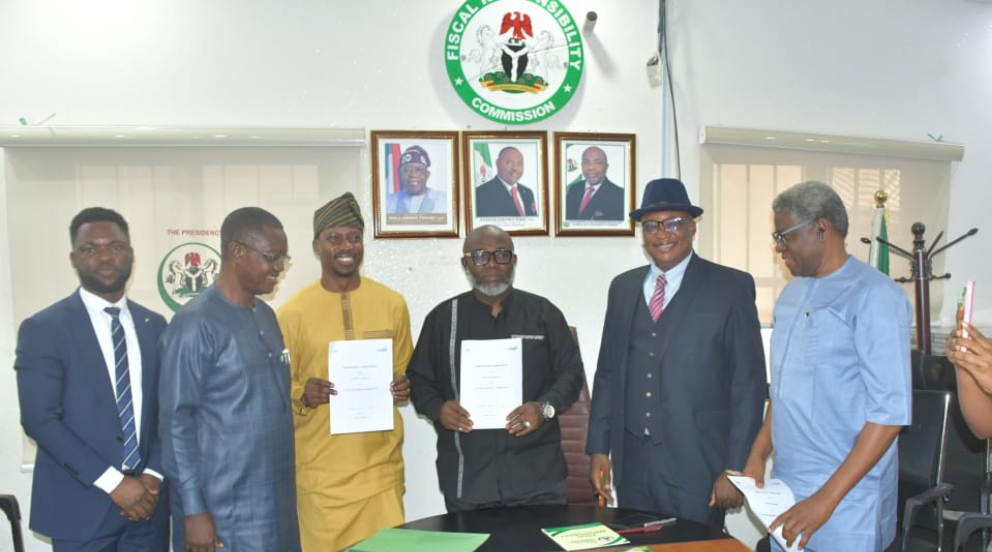
The Fiscal Responsibility Commission (FRC) has signed a landmark Memorandum of Understanding (MoU) with the BudgIT Foundation aimed at strengthening fiscal transparency, accountability, and citizen engagement in Nigeria’s public finance management system.
The signing ceremony, held at the Commission’s headquarters in Asokoro, Abuja, drew key stakeholders from the fiscal governance and anti-corruption ecosystem.
Speaking at the event, Dr. Emmanuel Uche, Project and Component Manager for Anti-Corruption under the EU Rule of Law and Anti-Corruption (RoLAC) Programme, commended the Executive Chairman of the Commission, Victor Muruako, for bringing renewed “fiscal responsibility energy” to the leadership and management of the FRC.
Dr. Uche noted that while the Fiscal Responsibility Commission was established under the Fiscal Responsibility Act (FRA) 2007 to check fiscal recklessness and ensure prudent management of public resources, certain structural limitations have constrained its enforcement capacity. He described the need to amend the Act to strengthen the Commission’s powers, particularly in sanctioning fiscal offenders.
“An important Commission set up to check fiscal rascality must not be weakened by legislative gaps. The National Assembly should consider amendments that will empower the Commission to effectively discharge its mandate,” Dr. Uche stated.
He added that strengthening the FRC would significantly enhance Nigeria’s fiscal governance architecture and reinforce anti-corruption efforts nationwide.
BudgIT Applauds Commission’s Impact
In his remarks, Deputy Director of BudgIT Foundation, Mr. Vahyala Kwaga, praised the Commission’s recent performance, stating that its outputs have become increasingly visible and impactful under the current leadership.
He described Chairman Muruako as a reform-oriented leader committed to advancing fiscal discipline and public accountability.
“The Commission’s work today is visible, measurable, and impactful. This partnership will further amplify transparency initiatives and deepen collaboration between government and civil society,” Kwaga said.
Executive Chairman Victor Muruako explained that the MoU represents a strategic step toward strengthening collaboration between the FRC and BudgIT in the areas of fiscal oversight, citizen engagement, and institutional capacity building.
According to him, the agreement aligns with the Commission’s broader reform agenda to promote fiscal discipline across all tiers of government.
“This collaboration is designed to enhance transparency, improve public participation in fiscal processes, and reinforce accountability mechanisms in Nigeria’s public finance management system,” Muruako stated.
He also reiterated the need for legislative amendments to the Fiscal Responsibility Act to enhance the Commission’s enforcement authority. Additionally, he called for improved staff welfare and remuneration to enable personnel to deliver optimally in service to the nation.
The Memorandum of Understanding establishes a structured framework for cooperation between the two institutions in the following areas:
Civic Technology Integration: Deployment of BudgIT’s transparency platforms, including Tracka and the BudgIT Budget App, to support fiscal monitoring and citizen feedback.
Data Sharing and Research Support: Provision of fiscal-related data (subject to legal constraints) and collaborative policy analysis.
Joint sensitization campaigns, town hall meetings, and community dialogues.
Capacity Building: Training programs for FRC staff, journalists, youth groups, and civil society actors.
Institutional Coordination: Designation of liaison officers to ensure effective implementation of the partnership.
The MoU also contains provisions on confidentiality, dispute resolution, anti-corruption compliance, non-exclusivity, and termination procedures.
Observers note that the partnership signals a growing synergy between regulatory institutions and civic technology organizations in Nigeria’s accountability landscape. By combining statutory oversight functions with data-driven citizen engagement tools, the collaboration is expected to enhance transparency, improve monitoring of public resources, and support ongoing fiscal governance reforms.
(FRC Media)