Nigeria’s Marine and Blue Economy Sector Sees Significant Reforms, Launches Digital Platform to Drive Transparency, Efficiency
Oru Leonard
The Minister of Marine and Blue Economy, Adegboyega Oyetola, has announced significant progress in the sector, with local fish production increasing from 1.1 million metric tons to 1.4 million metric tons in 2025. The ministry has also commenced engagements with financial institutions to facilitate single-digit interest loans for fish farmers, aiming to boost productivity and food security.
Recall that Nigeria was elected into Category C of the International Maritime Administration recently, affirming its global relevance and leadership.
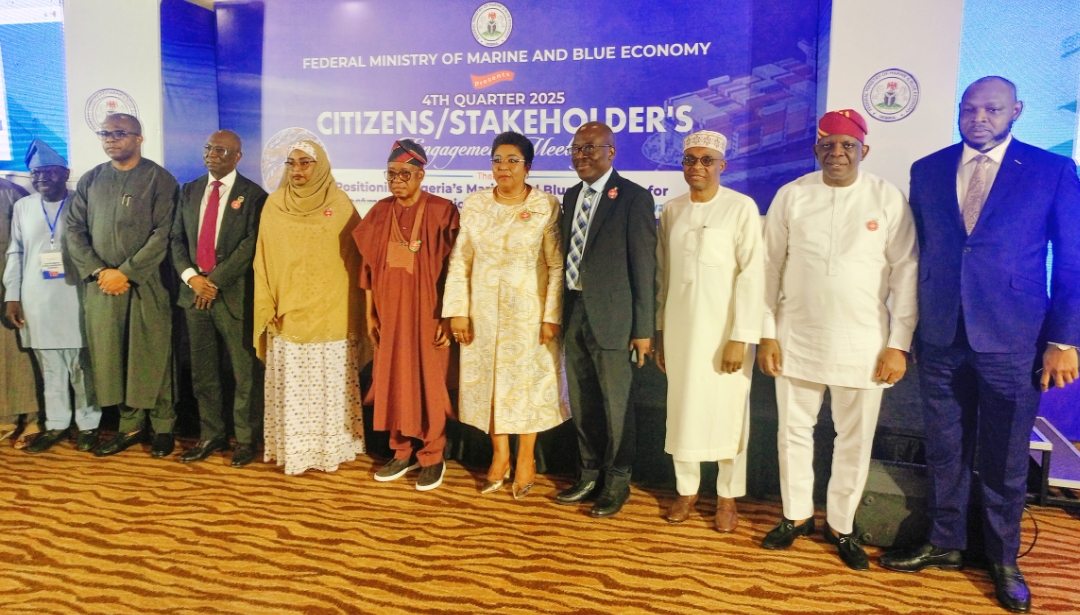
Delivering his keynote address at the 4th Ouarter 2025 Citizens/ Stakeholders E Meeting themed: “Positioning Nigeria’s Marine and Blue Economy for Investment, Innovation and Expansion: The Pathway.”, Dr. Oyetola described the engagement as a defining moment in Nigeria’s drive to reposition the marine and blue economy as a critical pillar of economic diversification, growth, and global competitiveness. He noted that the forum was deliberately designed to deepen transparency, accountability, partnership, and shared ownership of reforms in line with the Renewed Hope Agenda of President Bola Ahmed Tinubu, GCFR.
On Maritime Security, there has been zero piracy incidents in Nigerian waters for over three years, making it one of the safest maritime corridors in the Gulf of Guinea.
On Institutional Reforms, the launch of the Enterprise Content Management System (ECMS), was jointly performed by the Honourable Minister of Marine and Blue Economy, Dr. Adegboyega Oyetola, and the Head of the Civil Service of the Federation, Mrs. Didi Esther Walson-Jack, during the Ministry’s Fourth Quarter 2025 Stakeholders and Citizens Engagement held at the Transcorp Hilton Hotel, Abuja.
Speaking on the launch of the ECMS, the Minister described the platform as a strategic investment that goes beyond internal administration to drive efficiency, transparency, accountability, and improved service delivery.
“A digitally enabled Ministry is a more responsive Ministry,” he said. “Through the ECMS, we are streamlining workflows, strengthening records management, improving decision-making, and enhancing our capacity to support investors, operators, and partners with speed, clarity, and integrity.”
Highlighting the strategic importance of the sector, Dr. Oyetola said Nigeria’s extensive coastline, vast inland waterways, and strategic geographic location provide unique opportunities to harness maritime trade, fisheries, aquaculture, logistics, tourism, and allied services for inclusive growth, job creation, and regional integration
On future plans, the ministry says it will consolidate gains and deepen reforms;
strengthen institutions and expand infrastructure; sustain security and stability; promote private sector participation and investment
The minister emphasized the ministry’s commitment to transparency, accountability, and collaboration with stakeholders to drive growth and development in the marine and blue economy sector.
He futher said that the Ministry’s reform efforts have earned national recognition, citing a 96 per cent performance rating by the Central Results Delivery Coordination Unit (CRDCU), positive assessments from the Presidential Enabling Business Environment Council (PEBEC), and recent data from the National Bureau of Statistics ranking water transportation among the top five fastest-growing sectors of the Nigerian economy.
In her remarks, the Head of the Civil Service of the Federation, Mrs. Didi Esther Walson-Jack, commended the Ministry for its far-reaching reforms and notable achievements, particularly the successful go-live of the ECMS.
She described the digital platform as a significant step toward paperless governance, improved records management, and faster, more efficient service delivery within the public service. According to her, the ECMS will enhance institutional memory, reduce bureaucracy, improve accountability, and align the Ministry with the Federal Civil Service’s broader digital transformation agenda.
The event was attended by several industry stakeholders, including regulators, private sector operators, development partners, investors, and representatives from diverse segments of the marine and blue economy, all of whom reaffirmed their commitment to supporting the sector’s growth and sustainability.