MACS Foundation’s Bold Climate Push: AI, Academies and Action Take Centre Stage in Abuja
Oru Leonard
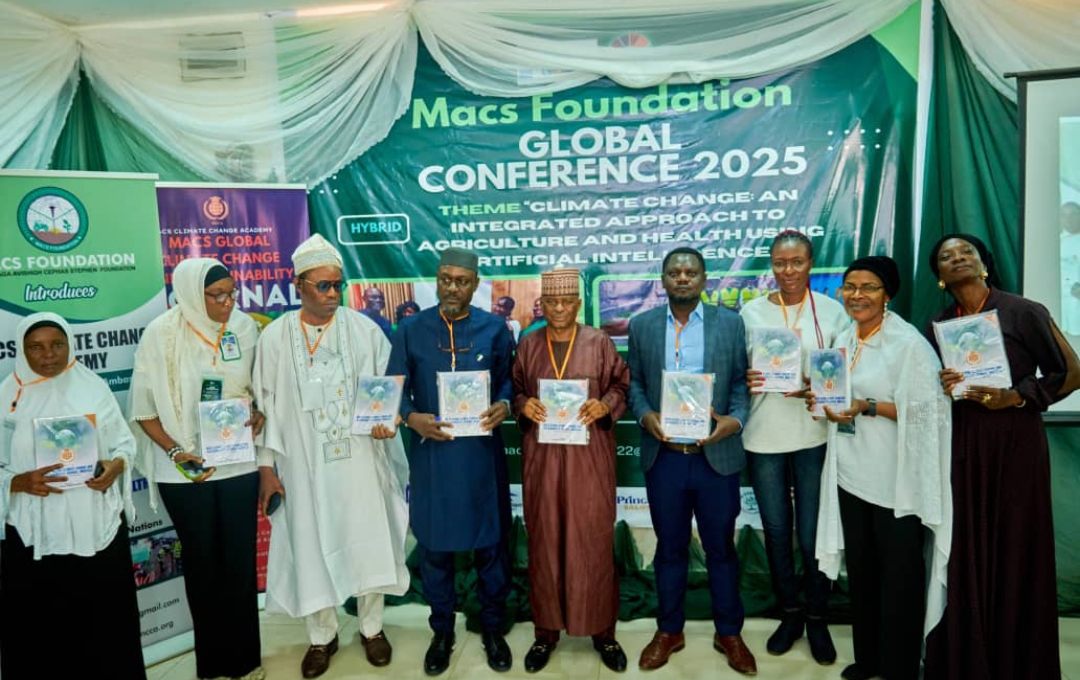
Abuja — In a two-day gathering that blended high-level ideas with grassroots ambition, the MACS Foundation last week launched what it calls a new era for climate education and accountability in Africa. The “Climate Change: An Integrated Approach to Agriculture and Health Using Artificial Intelligence” Macs Global Conference 2025. Held on October 30–31, 2025 in Abuja brought together researchers, policy actors, youth leaders, and practitioners for a programme that moved easily from technical panels to practical commitments.
At the heart of the event were three major launches. The MACS Climate Change Academy (MCCA) was unveiled as a structured, cohort-based training platform designed to turn learners into community practitioners; the MACS Global Climate Change and Sustainability Journal (MGCCSJ) was introduced as a peer-reviewed forum for policy-relevant research; and the Transformation Tracker was revealed as the Foundation’s media and monitoring arm, intended to follow development promises through to delivery at community level.
Organisers described the conference as deliberately hybrid: while Abuja hosted the physical convening, participants dialled in from across Africa and beyond. The result was a lively mix of local context and international frameworks, a recurrent theme as speakers linked everyday farming challenges and community health problems to global instruments like the SDGs, the Paris Agreement, and African Union climate strategies.
The conference’s keynote, “AI-Driven Agroforestry Designs that Improve Air Quality and Community Health,” delivered a practical entry-point into discussions that otherwise risked abstraction. Presented by Ambassador David AllGreen, the talk argued that artificial intelligence, paired with local knowledge, can optimise tree-planting schemes, improve carbon uptake modeling, and align agroforestry with public health outcomes. Rather than a narrow tech fetish, presenters framed AI as a tool that, when applied responsibly, strengthens long-standing community practices.
Technical sessions reinforced that view. Academics and practitioners addressed themes ranging from climate-smart agriculture and early-warning systems to biomass energy, heritage-driven resilience, and the links between environmental degradation, displacement, and local security. Papers explored how digital counselling supports mental resilience in climate-impacted zones, and how community stewardship can protect urban tree cover, a topic with obvious relevance to heat islands and air quality in growing cities.
Practical, Not Only Theoretical
A distinguishing feature of the conference was its insistence on “knowledge-to-action.” The MCCA curriculum was presented not as a series of lectures but as 12 action-oriented cohorts; each module is tied to a practical project in participants’ communities, and successful graduates will be recognised as “MCCA Climate Ambassadors.” The newly launched journal will publish peer-reviewed articles and policy briefs emerging from those projects, an attempt to close the research-to-practice gap.
The Transformation Tracker, meanwhile, pledges to document whether projects and public commitments produce measurable community changes. Organisers said the Tracker will publish updates and visual evidence of progress, thereby strengthening public accountability.
Recognition and Momentum
The conference also recognized leaders who have moved ideas into practice. Ambassador David AllGreen received an award for creative climate advocacy; Dr Umar Ibrahim Majalam was honoured for lifetime contributions linking environmental finance and agriculture; and Rt. Hon. Terseer Ugbor was lauded for legislative work on climate governance and environmental education.
More than ceremony, these recognitions signalled an intent: to celebrate a coalition of actors across public service, civic life and creative outreach whose work demonstrates the conference’s central thesis
, climate action must be multidisciplinary, locally rooted and policy-engaged.
Goodwill and Partnerships
Messages from partners, sponsors and civil society underscored institutional interest in the MACS agenda. Representatives commended the focus on youth, data-driven agriculture, and health linkages, while sponsors and partners pledged support for training, research and outreach. Macs Foundation stressed that the MCCA will seek multi-level partnerships across board to scale impact.
Participants resolved to translate conference outcomes into policy briefs and working papers for submission to relevant government departments. Among the priorities identified were integrating climate education into school curricula, boosting AI-supported early-warning systems for farmers, and strengthening community-based monitoring for adaptation projects.
A Forward-Looking Tone
What stood out during the two days was a pragmatic optimism. Presenters acknowledged the scale of the climate challenge and the real limits in funding and infrastructure, yet emphasised incremental, evidence-based interventions. The event’s blended approach, research, training, media accountability was presented as an integrated pathway for scaling local successes to national policy.
By launching an academy, a journal, and a tracker together, MACS Foundation made a public commitment to an ecosystem approach: training leaders, generating sound evidence, and ensuring that results are tracked and communicated. If those three elements are secured with partnerships and resources, the Foundation argues, African communities will be better placed to turn climate knowledge into tangible improvements in agriculture, health and livelihoods.
Next Step
Organisers say this conference is just the start. The MCCA will run cohort intake cycles, the MGCCSJ will publish quarterly, and the Transformation Tracker will begin rolling out regional monitoring updates. For participants and observers, the question is whether the new institutions will build durable collaborations, attract steady funding, and convert academic insight into field-tested solutions. If the energy at the two-day conference is any guide, there is now a clearer pathway for turning ideas into sustained climate action across Nigeria and the continent.
(Macs Foundation Media)