Johannesburg summit: A do-or-die moment for G20
By Kirtan Bhana
(This article was first published on CGTN: Johannesburg summit: A do-or-die moment for G20 and then Diplomatic Society, South Africa)
The G20 Summit in Johannesburg, South Africa, is the first time the forum convenes on African soil.
The symbolism is powerful, but the stakes are far greater. As the first African nation to hold the G20 presidency, South Africa is determined to center the development agenda of the Global South on “Solidarity, Equality, Sustainability.”
The G20 was founded after the 1997 Asian financial crisis, when the world recognized that global economic governance could no longer be shaped solely by advanced economies. Emerging economies demanded a seat at the table.
Today, two decades later, with the G20 grown into a broader economic and governance forum, that logic is even more compelling. Asia’s rise continues, Africa stands at the cusp of demographic and economic transformation, and the long-assumed dominance of the Global North is showing signs of fatigue, from sluggish growth to fractured politics.
That makes the Johannesburg summit an inflection point for global governance and a test of whether the G20 can remain relevant in a world where the balance of power is rapidly shifting.
South Africa’s presidency has been unambiguous, placing the needs of developing countries at the center. The following four priorities reflect the daily constraints that define life across the Global South:
Strengthening disaster-response capacity
Climate-linked disasters disproportionately hit developing nations, many of which lack early-warning systems, adaptation finance, or post-disaster recovery mechanisms. In his address at the World Economic Forum in January, South African President Cyril Ramaphosa said elevating disaster resilience to the G20 leaders’ agenda is overdue.
Ensuring debt sustainability for low-income countries
More than 50 developing nations face debt distress or are on the brink. Access to affordable finance remains elusive. South Africa’s leadership in convening a G20–Africa High-Level Dialogue on debt and cost of capital speaks to this.
Promoting an equitable energy transition
While rich nations, who are primarily responsible for excessive carbon emissions, push for rapid decarbonization, many developing economies fear the costs, job losses and instability that could follow if the transition is poorly financed. South Africa argues that climate justice must mean not only reducing emissions, but unlocking financing so that energy transitions create jobs, build industries and expand access.
Enhancing sustainable use of mineral resources and inclusive growth
Africa holds many of the essential minerals for a state-of-the-art global green economy. The question is whether the continent will once again be relegated to extracting raw materials for others, or whether it will ascend the value chain, industrialize and benefit from its own resources.
This summit is also taking place at a moment when the G20 itself faces internal fractures. On November 7, U.S. President Donald Trump said no American officials would attend this year’s G20 Summit for what he called “human rights abuses” in South Africa. This absence will cast a shadow, raising questions about the commitment of major powers to inclusive multilateralism.
But history shows that international forums often reinvent themselves during periods of crisis. The G20 itself emerged from crisis in 1999. The 2008–09 global financial meltdown transformed it from a ministerial gathering to a leaders’ summit. Today, as geopolitical tension and economic fragility challenge old institutions, the G20 once again confronts a choice: Renew or decline?
For South Africa, this moment is both a risk and an unprecedented opportunity. The Johannesburg summit could therefore be the moment the G20 becomes truly global, or the moment it loses relevance to emerging alternative frameworks.
Hosting the G20 for South Africa is a continental mandate. Through the African Union’s inclusion in the G20, and South Africa’s role as host, African leaders have been signaling that global governance must meaningfully reflect their interests.
The success of the summit will depend on three factors:
Clarity of the Global South’s demands. Debt reform, concessional finance, climate adaptation funds, industrial policy space and technology access must remain on the table.
Unity among developing countries. Fragmentation has historically undermined the influence of the Global South. A coordinated stance, particularly between Africa and Asia, will be decisive.
Concrete, monitorable commitments. Empty communiques will no longer suffice. The Global South needs deadlines, financing numbers, implementation mechanisms.
The world has changed since the G20’s founding in the turbulence of the 1990s. The Global South must steer global priorities.
The Johannesburg summit is a crossroads. If successful, it could reorient the G20 toward a more inclusive, development-centered future and reaffirm multilateralism at a time when the world needs it most. If it falters, the Global South may increasingly seek alternative frameworks to shape its destiny.
The moment demands leadership, and South Africa now has both the opportunity and the responsibility to deliver it.
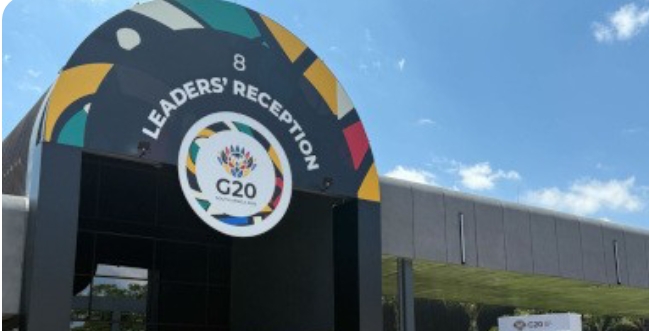
Cover Photo Caption: The site of the G20 Summit in Johannesburg, South Africa, November 21, 2025. /
CGTN – 22 November 2025
Kirtan Bhana, a special commentator on current affairs for CGTN, is the founding editor of the Diplomatic Society of South Africa, an international relations and diplomatic media platform.