House of Reps Slammed for ‘Reckless’ Proceedings and NPF Against Protesters

Oru Leonard
“For democracy to work, the people must be empowered to participate in the process, and the process must be transparent, credible, and free from manipulation.”
– Pat Utomi
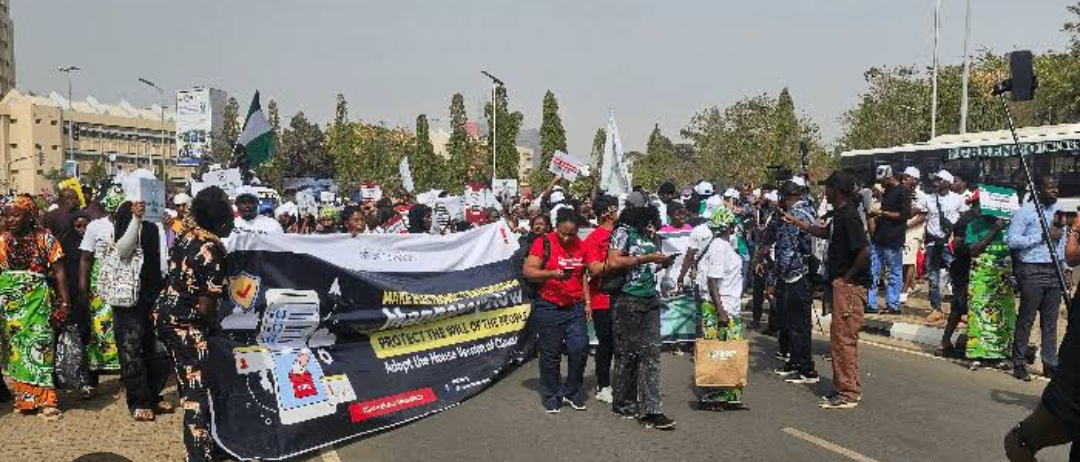
February 17, 2026, marked a troubling moment in Nigeria’s democratic journey, a day when the House of Representatives appeared to prioritise political expediency over the clearly expressed will of the Nigerian people, and when citizens exercising their constitutional right to peaceful assembly were met with force instead of dialogue. We condemn, in the strongest possible terms, both the conduct of proceedings on the floor of the House and the violent dispersal of peaceful protesters outside the National Assembly Complex.
Speaker Tajudeen Abbas presided over proceedings in which a motion was moved by Hon. Francis Waive, Chairman of the House Committee on Rules and Business, to rescind the Electoral Act (Amendment) Bill passed on December 23, 2025, specifically Clause 60(3), which mandates real-time electronic transmission of election results. The motion was subjected to a voice vote. By every audible indication within the chamber, the “nays” were louder than the “ayes.” Yet the Speaker ruled that “the ayes have it.” The subsequent walkout by lawmakers who objected to the ruling, and the disorder that followed, were not mere disruptions; they were a manifestation of deep concern about the integrity of the legislative process itself.
Ufuoma Nnamdi-UD, Executive Director of Enough is Enough Nigeria (EiE), stated:
“When elected representatives audibly oppose a motion, and the presiding officer declares the opposite, it raises serious questions about the integrity of the process. A voice vote is only legitimate when the outcome is clear and uncontested. When the result is visibly disputed, transparency demands a recorded vote. Nigerians are watching, and they will not forget.”
Equally disturbing was the deployment of anti-riot police and the firing of teargas at peaceful protesters gathered outside the National Assembly gates. These were regular Nigerians, students, professionals, traders, mothers, and fathers, who came to express concern about the future of their votes and the credibility of the upcoming elections. The response they received was force. We demand the immediate identification and prosecution of those who ordered and carried out this attack, a full apology from the Nigeria Police Force, and clear directives from the Inspector General of Police that citizens exercising their constitutional rights must never again be treated as threats to public order.
What happened is not an isolated incident. It reflects a broader and longstanding pattern in the National Assembly of resolving contentious matters through voice votes, a system that is opaque, easily manipulated, and wholly inadequate for high-stakes national decisions. We saw it when Senate President Godswill Akpabio presided over the approval of President Bola Ahmed Tinubu’s declaration of a State of Emergency in Rivers State through a voice vote, with far-reaching consequences for democratic governance and for Governor Siminalayi Fubara. We saw it during the proceedings involving Senator Natasha Akpoti-Uduaghan. We have seen it too many times to treat it as a coincidence. Each time, we have called on the National Assembly to adopt electronic voting for its own internal proceedings. Each time, we have been ignored.
This pattern matters beyond procedure. A legislature that resists transparent, recorded voting within its own chamber weakens its moral authority to question or dilute the electronic transmission of election results. As Akindeji Aromaye, Senior Media Associate at EiE Nigeria, stated:
“Transparency must begin at home. A National Assembly that refuses to adopt electronic voting for its own internal processes cannot convincingly argue against electronic transmission of results nationwide. You cannot demand trust from citizens while avoiding accountability within your own chamber.”
The Joint Conference Committee, chaired on the Senate side by Senator Simon Lalong and on the House side by Hon. Adebayo Balogun, has now concluded its work and adopted a harmonised text. The outcome is exactly what we feared when the House moved to rescind its stronger position on February 17. The final bill retains electronic transmission in principle but preserves the Senate’s manual fallback, allowing Form EC8A to serve as the authoritative basis for collation where network failures are claimed. There is no definition of what constitutes a network failure. There is no independent body to certify when one has occurred. There is no consequence for officials who declare or engineer a failure.
This is not a compromise. It is the Senate’s loophole, laundered through a conference process and dressed as consensus. We said it then and we say it now: a bill that allows manual collation to override electronic records is not a reform; it is a rearrangement of the conditions that produced 2023.
The ball now sits squarely with President Tinubu. We call on him to withhold assent and return the bill with specific, unambiguous demands: define transmission failure, establish independent certification, create a legal presumption in favour of IReV data, and impose criminal liability on officials who manipulate the process. Nigerians are not asking for the impossible. They are asking that what is recorded at the polling unit cannot be silently overridden on the way to the declaration. That is a democratic minimum, and it deserves a democratic response.
To every Nigerian who believes their vote should count, the time to act is now, and the action must go beyond Abuja. We call on citizens across the country to identify the members of the Joint Conference Committee representing their states and constituencies and to make their voices heard directly. Write to them. Call their offices. Show up where they can be found. The same energy on the streets of Abuja must now travel to Port Harcourt, Kano, Enugu, Ibadan, Kaduna, and every local government in between. Protests must be devolved.
If those in Abuja are holding the National Assembly accountable at its gates, then citizens in every state must hold their own representatives accountable at their own gates. These legislators were elected by us, funded by us, and they must answer to us. If they will not hear us in the chambers of the National Assembly, then we must take this conversation closer to home — to their constituency offices, their town halls, and the communities that sent them there in the first place. Because that is where their political survival truly lives, and that is where democracy ultimately speaks loudest.
We call on civil society organisations, professional associations, trade unions, student bodies, and community leaders across Nigeria to mobilise within their spheres of influence. This is not an Abuja issue. It is a Nigerian issue. The 2027 elections will be conducted in every Ward, Local Government, and State, and every Nigerian has a stake in whether the results can be manipulated.
And to President Bola Ahmed Tinubu: should this bill arrive on your desk in a form that removes or weakens the real-time electronic transmission requirement, we call on you to withhold assent. The Nigerian people are not asking for the impossible. They are asking for transparency. They are asking that their votes, cast at great personal cost, be counted and transmitted without interference or manipulation. That is not a partisan demand. It is a democratic one. And it deserves a democratic response. Your legacy, and the stability of this democracy, will be measured in part by this singular decision.
We will continue to advocate peacefully, consistently, and firmly for reforms that strengthen electoral integrity and protect every Nigerian’s right to participate freely in our democracy.
God bless the Federal Republic of Nigeria.
About Enough is Enough Nigeria (EiE Nigeria)
Enough is Enough Nigeria (www.eie.ng) is a network of individuals and organizations committed to instituting a culture of good governance and public accountability in Nigeria through active citizenship. EiE’s #RSVP – Register | Select | Vote | Protect is a key voter education campaign. EiE was an integral part of the #OccupyNigeria movement in 2012 and is very active in the #OpenNASS and #OfficeOftheCitizen campaigns.