APM Terminals Signs MoU to Develop Badagry Deep-Seaport
Oru Leonard
APM Terminals has signed a Memorandum of Understanding (MoU) to explore the development of the proposed Badagry Deep-Seaport, as the Federal Government intensifies efforts to expand Nigeria’s maritime infrastructure and attract long-term private-sector investment.
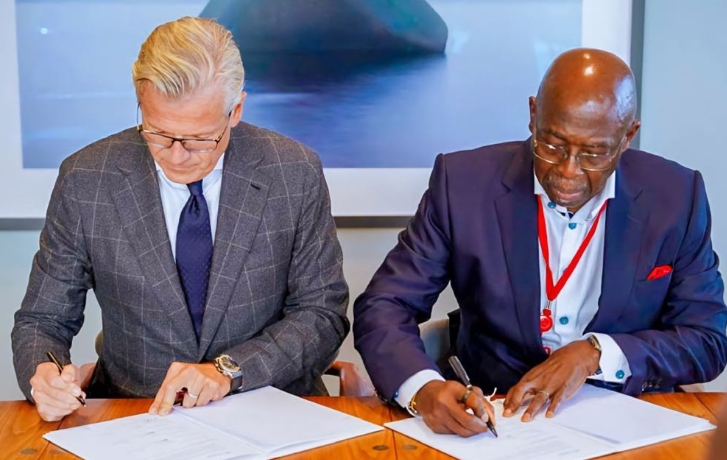
The agreement was signed in Copenhagen, Denmark, on Monday, September 7, 2026, during engagements between a Federal Government delegation led by the Minister of Marine and Blue Economy, Dr. Adegboyega Oyetola, and key stakeholders in the Danish maritime sector.
The MoU was signed on behalf of APM Terminals by the Group Chief Executive Officer of A.P. Moller–Maersk, Vincent Clerc, and by the Managing Director of Badagry Port Development Limited and Quinn McGrath Marine and Environmental Services Limited, Didi Ndiomu.
Under the agreement, the parties will enter into exclusive negotiations to explore the development of the Badagry Port, with APM Terminals expressing its commitment to advancing the proposed greenfield project.
The Badagry Deep-Seaport is expected to provide additional deepwater capacity, accommodate larger container vessels, increase cargo-handling capacity and create new opportunities for transshipment across Nigeria and the wider West African market.
Oyetola said the Federal Government was committed to modernising the country’s maritime infrastructure while creating an enabling environment for private investment.
He said the engagement with APM Terminals was consistent with the administration’s vision of positioning Nigeria as a major trade and logistics hub in West Africa.
As part of the discussions, the Federal Government and APM Terminals also considered the extension of the company’s port concessions at the Lagos Port Complex, Apapa, and the West Africa Container Terminal (WACT), Onne.
APM Terminals’ Managing Director, Africa & Europe, Igor van den Essen, said the company was interested in contributing to Nigeria’s economic growth and strengthening its position as a regional trade hub.
According to him, continued investment in the company’s existing concessions at Apapa and Onne, alongside the development of Badagry as a greenfield port, could help ease congestion at existing city ports and open new opportunities for trade.
He also said public-private partnerships could support long-term investment, improve the business environment and enhance Nigeria’s competitiveness.
Ndiomu described the proposed investment as the beginning of a new phase in Nigeria’s maritime development, saying the partnership would support the country’s ambition to become a major maritime centre in sub-Saharan Africa.
The proposed port is also expected to strengthen Nigeria’s regional transshipment capacity by providing a strategically located deepwater facility through which cargo destined for other West and Central African markets can be handled.
The development of the Badagry Deep-Seaport is therefore expected to complement existing port infrastructure, improve supply-chain resilience and expand Nigeria’s capacity to participate more effectively in regional and international maritime trade.