Integrated Transport System Critical to Nigeria’s $1tr Economy — FG
Maryam Aminu
Nigeria’s push to build a $1 trillion economy by 2030 has placed renewed focus on the urgent need to integrate road, rail, air and water transportation, as the Federal Government moves to reduce the country’s overwhelming dependence on roads and attract greater private-sector investment into the transport sector.
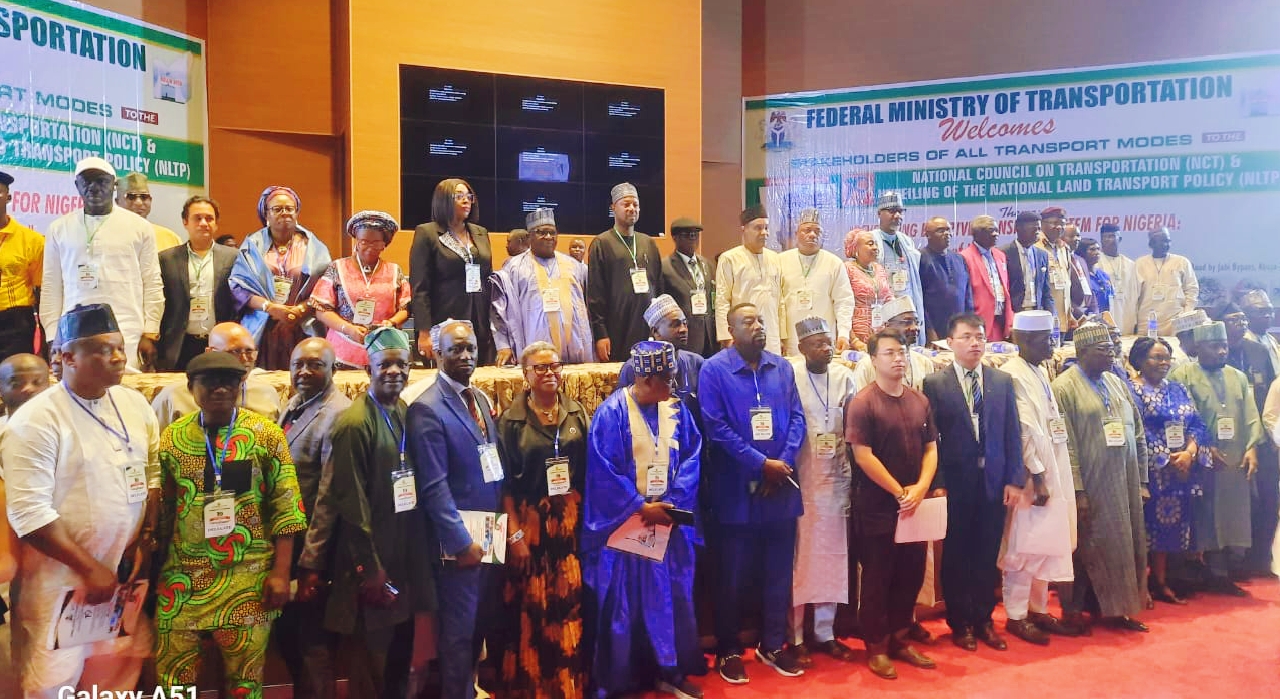
The call formed the central message at the 19th National Council on Transportation in Abuja.
The Council, attended by transport bureaucrats, regulators, operators, captains of industry and other stakeholders, is themed “Developing an Effective Transport System for Nigeria: The Role of Integrated Transportation.”
The Permanent Secretary, Federal Ministry of Transportation, Engr. Olufunso Adebiyi who is also Chairman of the Technical Committee of the National Council on Transportation, said the annual Council remained a critical platform for stakeholders to review progress, scrutinise setbacks, exchange ideas and replicate successful models across the country.
He said integrating Nigeria’s transport modes would reduce logistics costs, minimise transit times and create a seamless network for commuters and freight.
According to him, the country’s economic growth demands an “unyielding commitment to intermodal synergy,” stressing that Nigerians should have the freedom to choose their preferred means of transportation when travelling between destinations.
“Indeed, Nigerians deserve the right to choose for themselves their preferred transport mode when planning to take a trip from point A to point B. It should be their own prerogative,” Adeniyi said.
The Permanent Secretary identified the unveiling of the National Land Transport Policy as one of the major highlights of the 19th Council.
He said the policy, approved by the Federal Executive Council, would provide a stronger framework for regulating the land transport sector and boost investor confidence.
“It’s better late than never,” Adebiyi said, describing the policy as a long-standing aspiration of stakeholders in the sector.
He also called for a fundamental shift in transportation financing, urging Nigeria to move beyond heavy reliance on government budgets and develop frameworks capable of attracting sustained private-sector capital.
Adebiyi advocated transparent public-private partnerships, robust transport funds and innovative asset-recycling models.
He further challenged states to formalise clear transport master plans and develop policies capable of de-risking investments and attracting both local and multilateral funding.
The Permanent Secretary urged participants to use the three-day Council to engage in frank, data-driven and results-oriented deliberations and produce actionable blueprints capable of turning Nigeria’s transport corridors into engines of economic growth.
He said railway projects linking Kaduna, Zaria and Kano, as well as the Kano-Daura-Katsina corridor and other routes, were at various stages of completion.
He cited the movement of 33 forty-foot containers by train from Apapa Port to the Ibadan Dry Port as an example of rail’s capacity to reduce pressure on the Lagos-Ibadan corridor.
According to Adebiyi, the movement removed dozens of heavy-duty trucks from the road, with potential benefits for congestion, road safety and pavement preservation.
He also highlighted ongoing reconstruction and automation at the nation’s seaports, expressing optimism that improved port operations would make cargo movement faster, safer, more efficient and economical.
He said transportation was not merely about movement, but also a major driver of economic growth, trade, employment and productivity.
He cited thousands of Nigerians employed on major railway projects, including more than 4,000 workers on the Kano-Maradi project and over 5,000 on the Kaduna-Kano project.
The Permanent Secretary disclosed that the Federal Executive Council had approved the implementation of a Smart National Transport Data Bank under a Design, Build, Finance, Operate and Transfer model.
The proposed database is expected to provide comprehensive information on drivers, vehicles, licences, plate numbers and other road users.
He said the system would enable authorities to determine the number of licensed drivers and vehicles in the country while strengthening road safety enforcement.
He also advocated the standardisation of motor parks, with operators required to maintain passenger manifests containing names, telephone numbers, destinations and next-of-kin details.
Such a system, he said, would make it easier to identify passengers and provide critical information in the event of road crashes.
He further called for greater integration of vehicle registration and road-safety enforcement through computerised plate numbers and driver-licensing systems capable of identifying traffic offenders.
Adebiyi disclosed that the Federal Government had approved the development of standardised bus terminals, beginning with six locations.
He said the terminals would provide facilities including waiting areas, security posts, vehicle inspection and mechanical services, restaurants, restrooms, regulated parking and systems for managing unclaimed luggage.
Transport operators, he added, would be required to meet established criteria and obtain the necessary licences before commencing operations, while licences could be withdrawn for breaches of regulatory standards.
He also disclosed plans for a high-speed rail system linking Lekki to other parts of the country.
According to him, the proposed system could operate on elevated piers at speeds of about 360 kilometres per hour, providing Nigerians with an alternative to long-distance road travel.
He further disclosed plans for light rail projects in Kano, Kaduna and Lagos, with the expectation that similar systems would eventually extend to other state capitals.
He said efficient mass transit would reduce congestion and environmental impact, save travel time, lower transportation costs, improve productivity and enhance the quality of life.
Represented by Dr. Ishaku Musa, the Head of the Civil Service of the Federation, Abel Enitan said an efficient, integrated and resilient transport system was critical to Nigeria’s ambition of building a $1 trillion economy by 2030.
He described transportation as the lifeblood of a modern economy, noting that it connects people and communities, facilitates the movement of goods and services, expands access to markets, supports trade and investment and enables industrial and economic growth.
Enitan said Nigeria must develop a well-connected transport network in which road, rail, air and maritime transportation, pipelines and other logistics infrastructure operate as complementary components of an integrated system.
“For Nigeria to realize its full economic potential, we must develop a well-connected, efficient and resilient transport system in which road, rail, air and maritime transport, as well as pipelines and other logistics infrastructure, operate as complementary components of an integrated network,” the HCSF said.
According to the him, a modern multimodal transport architecture would enhance mobility, reduce logistics costs, improve the competitiveness of Nigerian businesses, strengthen domestic and regional trade, attract investment and unlock opportunities across virtually every sector of the economy.
Enitan said the transport sector must therefore receive greater attention as Nigeria pursues the one trillion US dollar economic target under the Renewed Hope Agenda of President Bola Ahmed Tinubu, GCFR.
However, he cautioned that infrastructure investment alone could not deliver the desired transformation.
He called for transport systems that are climate-resilient, sustainable, technology-enabled and responsive to the changing needs of Nigeria’s population and economy.
He also stressed the importance of competent professionals capable of planning, regulating, coordinating and managing the increasingly complex transport system.
The HCSF recalled that the Office of the Head of the Civil Service of the Federation, in collaboration with the National Council on Establishment, approved the creation of a dedicated transport officers cadre in 2019.
The cadre, he explained, was designed to strengthen institutional capacity and professional expertise within the Federal Public Service and improve the government’s ability to develop and implement sound transport policies.
“A high-performing transport sector therefore requires not only infrastructure and investment but also strong institutions, effective regulation, intergovernmental coordination, reliable data, innovation and a skilled public service,” the HCSF said.
Enitan urged participants to focus on practical outcomes by strengthening coordination across transport modes and deepening collaboration between federal and state governments.
It further stressed that the success of the Council would not be measured by the quality of its resolutions alone, but by the extent to which they were translated into policies, programmes and reforms capable of producing measurable improvements in the lives of Nigerians
The Keynote speaker Engr. Dr. Emmanuel John Chief Executive Officer Ochenuell Mobility Solutions said Nigeria must urgently diversify its transport investments and develop efficient mass-transit systems if it is to address growing congestion and improve movement within its cities, a transport expert has said.
The expert argued that “even cities cannot move, then we are not going anywhere,” stressing that the ability of people to move efficiently within urban centres is fundamental to national development.
As part of proposed investment options, he called for the development of a functional public transport system based on proper planning, clear policy direction and evidence-driven investment.
John specifically advocated increased investment in light rail systems capable of moving large numbers of people across cities, describing mass transit infrastructure as essential to addressing urban mobility challenges.
He also proposed the development of tram systems, which he described as a smaller form of light rail with certain advantages over other forms of public transportation.
Responding to concerns about electricity supply and the feasibility of electric transport systems in Nigeria, the expert pointed to successful examples in African cities that have developed electric urban transport systems without relying entirely on national electricity grids.
He cited Casablanca as an example, explaining that the city had demonstrated how modern electric public transportation could operate successfully despite challenges associated with national power supply.
John also drew comparisons between different forms of mass transit, including metro or heavy rail, light rail, transport and conventional public transport, highlighting the need for governments to assess the advantages and limitations of each system before making investment decisions.
He maintained that Nigeria’s transport challenge cannot be solved through isolated infrastructure projects but requires a comprehensive system that integrates appropriate modes of transportation with sound governance, investment and long-term planning.
The proposed shift, he said, would help Nigerian cities move away from car-dependent development and towards public transportation systems capable of supporting economic growth, reducing congestion and improving the quality of urban life.