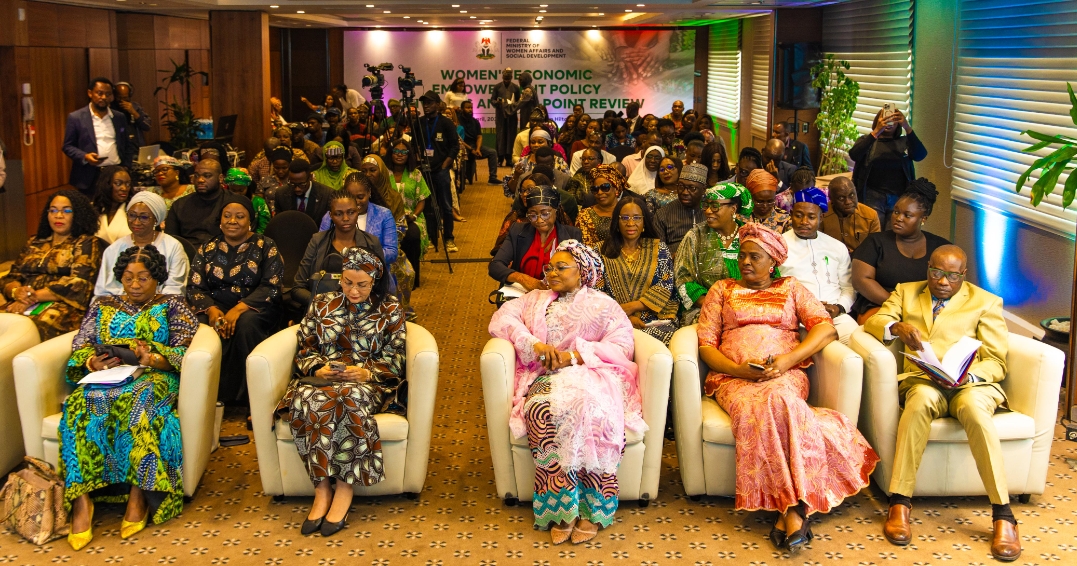
Nigeria Reviews Women Empowerment Policy, Targets Faster Economic Gains
Oru Leonard
The Federal Government of Nigeria has reaffirmed its commitment to advancing women’s economic inclusion as a cornerstone of national development, following a high-level midpoint review of the Women’s Economic Empowerment (WEE) Programme in Abuja.
The review, convened by the Federal Ministry of Women Affairs and Social Development in collaboration with Albright Stonebridge Group at the Transcorp Hilton Hotel, brought together key stakeholders across government, private sector, civil society, development agencies, and the media to assess progress and strengthen implementation strategies.
Speaking at the event, the Minister of Women Affairs and Social Development, Hon. Imaan Sulaiman-Ibrahim, described the WEE Policy as a strategic economic framework rather than a social initiative, noting that it is central to Nigeria’s long-term transformation agenda. She highlighted notable achievements since its launch, including adoption across several states such as Kaduna, Kano, Lagos, and Kwara, with a majority of states showing commitment to implementation.
The Minister also outlined the integration of the WEE agenda into flagship national programmes under the Renewed Hope Social Impact Interventions (RHSII-774), including EmpowerHer, WAVE 774, PowerHer 774, Her SafeHaven, Families First Initiative, and DigitalHer. According to her, these initiatives are designed to enhance inclusion, boost productivity, and build resilience among women nationwide.
She further linked the programme to President Bola Ahmed Tinubu’s declaration of 2026 as the “Year of Families and Social Development,” emphasizing that empowering women directly strengthens families, improves child welfare, and fosters resilient communities.
Also speaking, the Minister of State for Budget and Economic Planning, Dr. Doris Uzoka-Anite, who represented Minister Atiku Bagudu, stressed the economic importance of closing gender gaps in access to finance and labour participation. She disclosed ongoing efforts to institutionalize gender-responsive planning and budgeting across Ministries, Departments, and Agencies to ensure measurable outcomes for women.
Uzoka-Anite added that partnerships with institutions such as the Bank of Industry, AFAWA, and UN Women are being leveraged to mobilize blended finance and expand access to capital for women-led businesses.
In her remarks, the Permanent Secretary of the Ministry, Mrs. Asanye Nko Esuabana, described the review as a critical opportunity to evaluate progress and refine implementation strategies. She pointed to the development of the WEE Costed Framework as a major milestone, enabling structured planning, improved accountability, and enhanced resource mobilization.
Representing UN Women, Programme Manager Osalobo Osemhenjie commended Nigeria’s leadership on gender inclusion while noting that persistent challenges—such as limited access to finance, unpaid care burdens, and socio-cultural barriers—continue to hinder women’s full economic participation. She called for sustained commitment, increased funding, and stronger accountability systems.
The meeting also showcased innovative tools like the Happy Woman App, designed to connect women with opportunities and resources, as well as the expansion of the Nigeria for Women Programme, which aims to reach 4.5 million women through community-based affinity groups.
Stakeholders unanimously agreed that the midpoint review signals a renewed push for accelerated action, with emphasis on execution, coordination, and scaling impact nationwide.
As Nigeria moves toward its 2028 targets, the WEE Policy is positioned as a transformative vehicle to ensure that economic opportunity is driven by potential rather than gender, reinforcing women’s role as key drivers of sustainable growth.