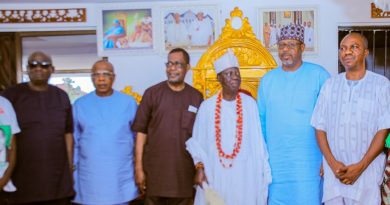
Between Political Boasts and Data Truths: Why Tajudeen Abbas Must Meet Nentawe Yilwatda on the Field of Evidence Before 2027
By Citizen Bolaji O. Akinyemi
In politics, optimism is not a crime. It is, in fact, a necessary fuel. Every party must project confidence; every leader must inspire belief. So when Tajudeen Abbas declares that the All Progressives Congress has been accepted “100% in all the nooks and crannies of Kaduna,” he is performing a familiar political ritual—reassuring the base, projecting strength, and signaling readiness for 2027.
But beyond the theatre of politics lies the science of governance. And it is here that statements like these must be carefully interrogated—not to embarrass the speaker, but to protect the party, the process, and ultimately, the credibility of democracy itself.
Nigeria today is too fragile, too complex, and too politically conscious to be navigated on assumptions dressed as certainty.
The danger is not in making bold claims. The danger is in believing them without evidence.
This is precisely where Nentawe Yilwatda becomes central to the conversation. For the first time in Nigeria’s contemporary political history, a party as dominant as the APC is being administered by a man whose intellectual formation is deeply rooted in data, systems thinking, and empirical validation. His public engagements—particularly his emphasis on data as the backbone of modern governance—stand in sharp contrast to the culture of political guesswork that has historically defined electoral strategy in Nigeria.
This is not a coincidence. It is an opportunity.
If the APC under his leadership fails to distinguish between measured reality and manufactured perception, then it would have squandered one of the most significant intellectual advantages ever presented to a Nigerian political party.
The claim of “100% acceptance” in Kaduna State must therefore be treated not as a conclusion, but as a hypothesis—one that demands rigorous testing.
Because the truth is this: no society that is politically alive records absolute consensus. Not in Kaduna. Not in Lagos. Not anywhere in Nigeria. Even the most transformative governments in history have had dissenting voices. Democracy itself is built on plurality, not uniformity.
To assume total acceptance is to risk strategic blindness.
And political blindness, especially in a country like Nigeria, is costly.
What then should be done?
The answer is neither complicated nor unprecedented. The APC must institutionalize a credible, transparent, and scientifically conducted public opinion poll—starting with Kaduna State and extending nationwide—to measure the true acceptance level of Bola Ahmed Tinubu and the party across demographics, zones, and socio-economic categories.
This is not an act of weakness. It is an act of intelligence.
A party that seeks re-election must first seek truth.
Such a poll would achieve multiple strategic objectives. It would separate enthusiasm from reality. It would identify strongholds and expose vulnerabilities. It would reveal not just whether people support the government, but why—or more importantly, why not. It would provide the empirical foundation upon which messaging, policy adjustments, and grassroots engagement strategies can be built.
Without this, the APC risks entering the 2027 elections armed with confidence but not clarity.
And confidence without clarity is a dangerous weapon—it often misfires.
There is also a deeper issue at stake: credibility.
The 2023 elections left behind a trail of contested perceptions, skepticism, and unresolved questions in the minds of many Nigerians. Whether justified or not, that perception exists. Therefore, the pathway to 2027 cannot be paved with declarations alone; it must be constructed on verifiable, independently testable data that Nigerians can trust.
If Bola Ahmed Tinubu is indeed widely accepted—as Tajudeen Abbas suggests—then a public poll will not weaken that claim; it will validate and amplify it.
But if there are gaps—and there almost certainly are—then early discovery becomes a strategic advantage rather than an electoral shock.
This is where leadership must rise above comfort.
Nentawe Yilwatda must insist that the party does not become a victim of its own internal applause. He must demand evidence where others offer assurances. He must build systems that measure reality, not mood.
Because history will not be kind to a data-driven professor who presides over a politically blind process.
The future of the APC in 2027 will not be determined by how loudly it celebrates its acceptance today, but by how honestly it measures it.
Kaduna is not just a state in this conversation—it is a test case. A mirror. A signal.
If the party gets Kaduna wrong in its internal assessment, it may get Nigeria wrong in its national calculation.
And by then, it may be too late to recalibrate.
The time to test assumptions is now.
The time to confront reality is now.
The time to replace political poetry with statistical truth is now.
Let the boast meet the data.
Let the claim submit to measurement.
Let confidence bow to evidence.
Only then can 2027 be approached not as a gamble—but as a strategy grounded in truth.