
Nigeria’s Trade Paradox: Oil Windfall Masks Deep Industrial Deficit- Expert
Oru Leonard
Abuja, Nigeria —A political economy expert, Mr Uchenna Nnadi has revealed a stark contradiction at the heart of the nation’s economy, where strong export figures driven by crude oil conceal deep structural weaknesses in non-oil sectors.
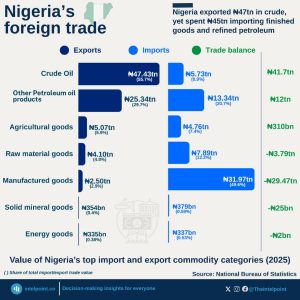
Using the Nigeria’s 2025 trade data which recorded an overall trade surplus of ₦20.71 trillion. He noted that, a closer breakdown shows that this surplus is overwhelmingly dependent on crude oil exports, which alone accounted for ₦47.43 trillion—exceeding the combined contributions of all other sectors.
According to him, “When crude oil is excluded, the narrative shifts dramatically. The country faces a non-oil trade deficit of ₦26.72 trillion, underscoring a heavy reliance on a single natural resource to sustain external trade performance.
The petroleum sector itself reflects a troubling imbalance. While Nigeria exported ₦25.3 trillion worth of petroleum products, it also imported ₦13.3 trillion in refined fuel—highlighting continued dependence on foreign refineries to process domestically extracted crude.
The manufacturing sector presents an even more concerning picture. Imports of manufactured goods surged to ₦31.97 trillion, compared to a modest ₦2.5 trillion in exports—an imbalance of nearly 12 to 1. Analysts say this gap illustrates the long-term decline of local industry, with Nigeria increasingly dependent on foreign goods for consumption and production.
Agriculture, despite its vast potential and large workforce, contributed only a marginal net trade surplus of about ₦310 billion. Meanwhile, other sectors such as energy goods and solid minerals recorded minimal activity, each contributing less than ₦400 billion in both imports and exports.
Economic observers warn that the figures highlight an urgent need for diversification, industrial revitalisation, and investment in value-added production. Without structural reforms, they say, Nigeria risks remaining trapped in a cycle of exporting raw materials while importing finished goods at a premium.
The 2025 trade performance, while positive on the surface, ultimately reflects an economy still grappling with the challenge of converting natural resource wealth into broad-based industrial growth.”
Cover Photo Credit: Business Day