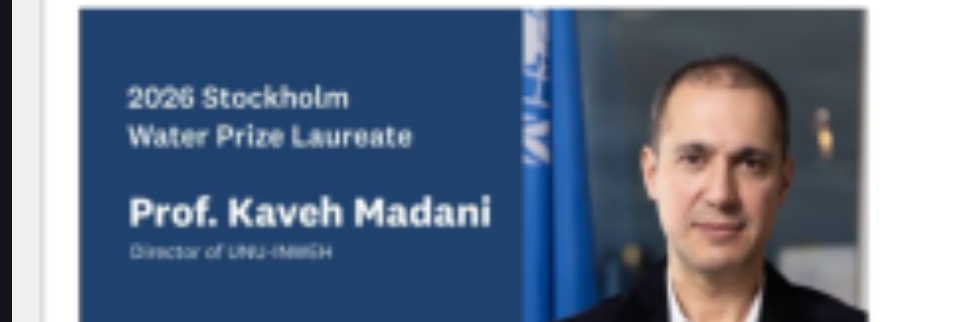
Exiled UN Scientist Wins 2026 Stockholm Water Prize
Oru Leonard
A leading global water expert, Kaveh Madani, has been named the 2026 laureate of the Stockholm Water Prize, widely regarded as the “Nobel Prize of Water.”
The announcement was made on March 18 at UNESCO headquarters in Paris, ahead of World Water Day. Madani, currently Director of the United Nations University Institute for Water, Environment and Health, will officially receive the award in August from Carl XVI Gustaf during World Water Week in Stockholm.
At 44, Madani becomes the youngest recipient in the prize’s history, as well as the first UN official and former politician to earn the honour. He was recognised for his groundbreaking work linking water science with policy, diplomacy and public engagement, often under significant personal and political risk.
Madani is widely known for developing the concept of “water bankruptcy,” a framework describing the world’s transition from temporary water crises to long-term, systemic water depletion. His work has influenced global discourse and policymaking on water management and sustainability.
His journey to international recognition has been marked by controversy and resilience. After returning to Iran in 2017 to serve as a senior environmental official, Madani faced backlash for advocating reforms and transparency in water governance. He was later arrested, subjected to smear campaigns, and forced into exile before continuing his work in academia and eventually at the United Nations.
Today, he is regarded as a leading voice in global water policy, combining scientific research with advocacy and digital outreach to raise awareness about water scarcity and environmental sustainability.
The Stockholm Water Prize committee praised his “unique combination of groundbreaking research and global impact,” noting his role in advancing understanding of complex water challenges and shaping international responses.
The award highlights both Madani’s scientific contributions and his efforts to elevate water as a central issue in global climate and development discussions.