Before Nigeria Becomes a One-Party State …. Democracy, Diversity, and the Dangerous Road Ahead
By Citizen Bolaji O. Akinyemi
My recent article, “One Party State: Tinubu’s Long Power Game; Our Present Political Reality,” raised an uncomfortable but necessary question about the future of Nigeria’s democracy. It examined the strategic weakening of opposition politics and the growing possibility that Nigeria may gradually drift toward a dominant-party political order.
That article sparked an invitation to discuss the issue on national television. The reason is clear: Nigerians are beginning to sense that something deeper is unfolding within the architecture of our political system.
The warning, is worth repeating and expanding.
If current trends continue unchecked, Nigeria may soon find itself walking toward a political destination that history has already mapped and pattern has confirmed— the quiet emergence of a one-party dominant state.
Before we reach that point, it is necessary to examine the implications for a country as diverse and complex as Nigeria.
*The Illusion of Stability in One-Party Systems*
In global politics, several nations operate under one-party political systems. Countries such as China, North Korea, and Cuba provide examples where political competition has been replaced by centralized party authority.
These systems are sustained by specific historical conditions: ideological uniformity, centralized political authority, and tightly controlled institutions.
In China, the political system revolves around the dominance of the Chinese Communist Party. The party’s authority is embedded within the structure of the state itself. Political opposition is not merely weak — it is structurally impossible.
Such systems may project stability, but they are fundamentally different from the democratic pluralism that countries like Nigeria claim to practice.
Can the world afford the model that Nigeria will become on the African continent. Where sitting tight seems to be the desire of every occupant of the seat of power?
Mind you, Nigeria was never designed to operate under such a structure.
*Nigeria: A Plural Nation, Not an Ideological State*
Our peculiarity, deserves an adventure of a home grown democratic system of government. Nigeria is one of the most complex societies in the world, no doubt. With more than 250 ethnic groups, multiple languages, and deeply rooted religious identities, the Nigerian state survives largely because political competition allows diverse interests to negotiate power peacefully.
Elections serve as a democratic safety valve through which grievances, ambitions, and aspirations find legitimate expression.
When political competition disappears, those tensions do not disappear with it. They simply migrate to more dangerous arenas.
In such circumstances, identity politics intensifies, regional grievances deepen, and political conflicts can transform into existential national disputes.
*The Contradictions of the 1999 Constitution*
Nigeria’s current constitutional order, embodied in the Constitution of the Federal Republic of Nigeria (1999), is itself a document filled with contradictions.
On one hand, it proclaims Nigeria to be a secular state, where government shall not adopt any religion as state policy.
On the other hand, the same constitutional framework accommodates the operation of Sharia law through Sharia courts within parts of the federation, in principle, hang on Nigeria a subtle tag as an Islamic state.
This uneasy coexistence between secular constitutional language and religious legal structures reflects the complex compromises that have historically held Nigeria down from rising to fulfil her destiny. Ensuring we stay together moving in circles.
But even with all its imperfections, the constitutional architecture never envisioned the emergence of a one-party state.
Multiparty democracy remains the central assumption upon which the entire system rests.
*A Dangerous Political Question*
The gradual weakening of opposition politics therefore raises a troubling question.
If Nigeria drifts toward a dominant-party political system, what ideological direction will the state ultimately assume?
No one-party system in the modern world operates as a neutral secular structure. Every dominant-party system eventually reflects the ideological orientation of the political coalition that controls it.
We must not be lost to the Muslim/Muslim ideological coalition that preceded the 2023 election.
This raises an uncomfortable but necessary question within Nigeria’s current political moment.
Could the consolidation of political power under the administration of Bola Ahmed Tinubu as President and Kasim Shettima strategically tilt the long-standing constitutional balance between secular governance and religious political influence right under our nose?
This is not an accusation.
It is a structural concern.
Political systems evolve according to the forces that dominate them.
And ideological systems — including religious legal traditions — historically flourish most easily within environments where political competition is weak and power becomes centralized.
The concept of Sharia governance itself historically emerges within dominant authority structures, not fragmented competitive political systems.
Nigeria must therefore think carefully before drifting toward any political order where one coalition becomes structurally unchallengeable.
*The Risk of Democratic Stagnation*
The greatest danger is not that Nigeria will suddenly resemble North Korea or Cuba.
The danger is subtler.
Nigeria may gradually evolve into a procedural democracy without meaningful competition — a system where elections still occur but political outcomes become increasingly predictable.
When this happens, democratic accountability weakens.
Institutions lose their independence.
Political elites lose the incentive to reform.
Citizens lose faith in the power of their votes.
And once public trust erodes, democratic systems begin to decay from within.
*A Dangerous Moment in Our Political History*
Nigeria today stands at a delicate historical crossroads.
The weakening of opposition parties, the consolidation of political networks around a dominant ruling structure, and the gradual disappearance of competitive political space together signal a transformation that must not be ignored.
Democracy does not collapse only through military coups.
Sometimes it fades quietly through the slow disappearance of meaningful political alternatives.
For a nation as diverse as Nigeria, such a development carries risks far beyond electoral politics.
It threatens the delicate balance that sustains the federation itself.
*A Final Warning*
The Nigerian republic has survived many political experiments — military rule, constitutional transitions, and shifting political alliances.
But one principle has remained central to the stability of the Fourth Republic:
competitive plural democracy.
If Nigeria abandons that principle, intentionally or accidentally, the consequences may unfold slowly at first — and then suddenly.
This is why the current political moment demands vigilance, courage, and democratic imagination from citizens across the country.
Nigeria must not quietly slide into a one-party future.
For a nation as complex as ours, political competition is not merely a democratic ideal.
It is a national necessity.
Citizen (Dr) Bolaji O. Akinyemi President, Voice Of His Word Ministries, BoT Chairman, Project Victory Call Initiatives, Popularly known as PVC Naija. An
Apostle & Nation Builder. He’s also the Convener Apostolic Round Table. He is a strategic Communicator and the C.E.O, Masterbuilder Communications.
Facebook:Bolaji Akinyemi.
X:Bolaji O Akinyemi
Instagram:bolajioakinyemi
Phone:+2348033041236
For feedback and to read more from him visit:
https://www.bolajioakinyemi.com/
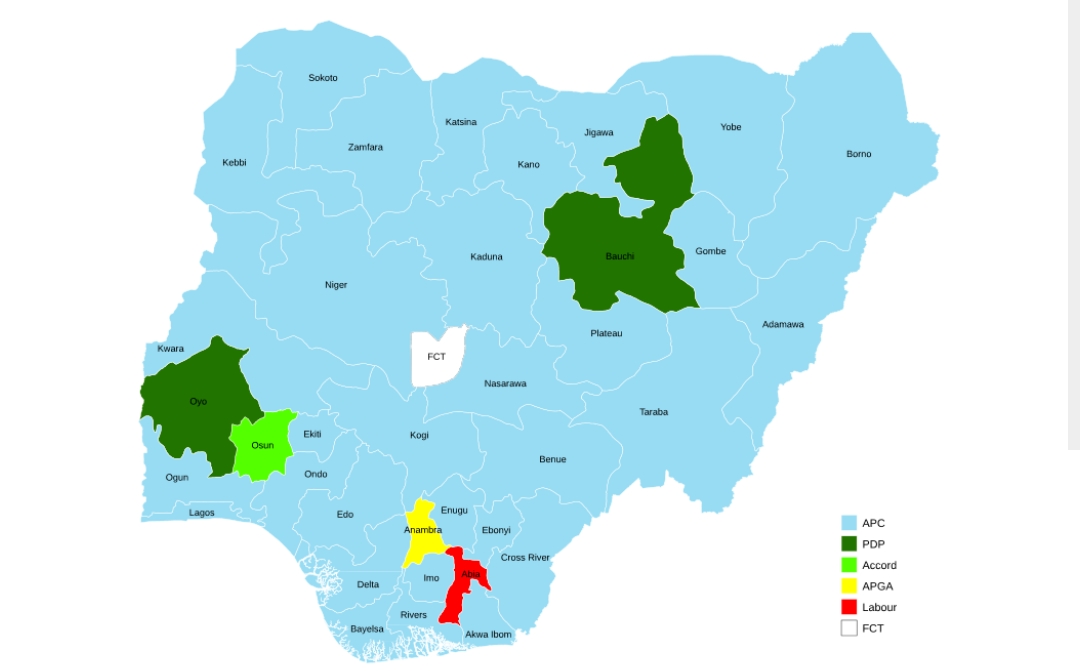
Party affiliation of current Nigerian state governors:
Photo Credit: Wikipedia