Amupitan warns against Nigligence, Swears in New Enugu, Appraises FCT, Kano and Rivers Elections
Oru Leonard
The Chairman of the Independent National Electoral Commission (INEC), Professor Joash Amupitan, has cautioned stakeholders involved in election administration and logistics against negligence and dereliction of duty capable of disrupting voting processes.
Prof. Amupitan gave the charge on Wednesday, 25 February 2026, during a high-level meeting with Resident Electoral Commissioners (RECs) at the Commission’s headquarters in Abuja.
The meeting reviewed the recently concluded elections in the Federal Capital Territory (FCT), Kano State and Rivers State, addressed operational challenges, and outlined strategies ahead of the 2027 General Election.
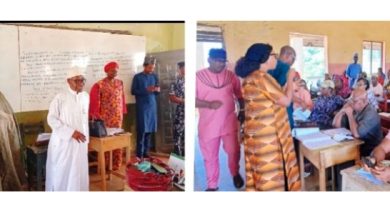
The event also featured the swearing-in of Dr. Chukwu Chukwu-Emeka Joseph as Resident Electoral Commissioner for Enugu State.
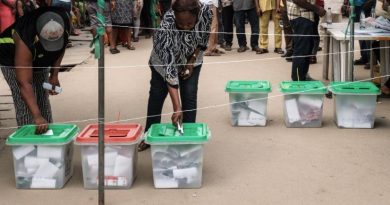
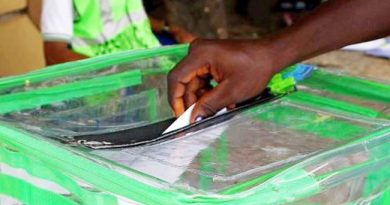
The INEC Chairman commended staff in the FCT, Kano and Rivers States for the successful conduct of the FCT Area Council election and bye-elections in Kano Municipal and Ungogo State Constituencies, as well as Ahoada East II and Khana II State Constituencies in Rivers State.
He noted that the elections were largely peaceful, with results promptly announced, except in Kuje Area Council, where difficult terrain in Kabi Ward delayed final collation until Sunday afternoon. By 2:00 p.m. on Sunday after the polls, over 93 per cent of polling unit results had been uploaded to the Commission’s Result Viewing Portal (IReV). As of the meeting date, an average of 97 per cent of FCT results had been successfully transmitted, underscoring the Commission’s commitment to transparency and timely reporting.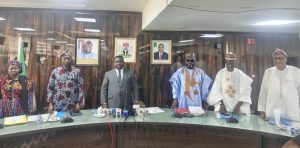
Prof. Amupitan acknowledged that voter apathy remains a challenge but reported a modest improvement in the FCT, where turnout increased from 9.4 per cent in 2022 to approximately 15 per cent in 2026. Over 239,000 voters cast ballots, compared to 148,685 in the previous election cycle. He stressed the need for sustained voter education and sensitisation to boost participation and public confidence.
Addressing allegations of “voter migration,” the INEC Chairman clarified that no voter was migrated in 2026. He explained that voter redistribution occurred in 2022 under the Commission’s Expansion of Voters’ Access to Polling Units initiative, during which over 56,000 new polling units were created nationwide, increasing the total from 119,972 to over 176,000.
In the FCT alone, 411 polling units were decongested, with about 580,000 voters reassigned to 1,156 polling units. Spill-over Voting Points created within the same premises were administrative measures aimed at reducing congestion and improving efficiency, without altering voter registration status or relocating voters to different communities. The Commission also sent refresher text messages and emails to affected voters and displayed the Register of Voters ahead of the February elections.
The Chairman expressed concern over delays in the opening of polling units, revealing that only 45 per cent of FCT polling units were operational by 8:30 a.m., although all were open by 10:00 a.m. He described the initial delay as unacceptable.
Staff responsible for delays in Kuje Area Council and Kabusa Ward have been queried, while a transporter linked to delays in Kwali Area Council will be blacklisted. INEC is reviewing its transport logistics model to improve timeliness in future elections.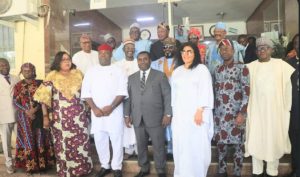
While commending security agencies for maintaining peace, Prof. Amupitan acknowledged incidents at the Kuje Central Collation Centre and another centre in Kwali Area Council, which were promptly resolved to ensure successful collation of results. He urged RECs to strengthen coordination with security agencies and local stakeholders.
On result management, the Chairman highlighted improvements requiring Presiding Officers to capture and upload images of completed Form EC8A to IReV and directly enter party scores into the BVAS device. The system conducts internal validation checks to prevent over-voting, ensure mathematical consistency and flag discrepancies. These measures, he said, were successfully tested and confirmed accurate during the recent elections.
On preparations for 2027, following the enactment of the Electoral Act, 2026, the INEC Chairman announced that the Commission will issue a revised Timetable and Schedule of Activities for the 2027 General Election. The earlier Notice of Election issued on 13 February 2026 under the previous law will be adjusted to comply with the new legal framework.
He also disclosed that INEC will soon commence a comprehensive Voters Revalidation Exercise to sanitise the register ahead of 2027.
The second phase of the Continuous Voter Registration (CVR), which began on 5 January 2026, remains ongoing until 17 April 2026, while the full exercise is scheduled to conclude on 30 August 2026. RECs were urged to intensify public awareness to ensure eligible Nigerians complete their registration.
Dr. Chukwu Chukwu-Emeka Joseph, a lecturer at the University of Nigeria, Nsukka (UNN), was sworn in as Resident Electoral Commissioner for Enugu State. He hails from Abia State and previously served in Enugu and Ebonyi State.
Congratulating him, Prof. Amupitan said:
“Your dedication, expertise and commitment to upholding the democratic process have not gone unnoticed. You stand at the forefront of our electoral system, and with this mandate comes both responsibility and opportunity. As you embark on this second tenure, remember that your responsibility is not only administrative but institutional. You must continue to inspire confidence, strengthen processes and ensure that elections under your watch are free, fair and credible.”