NSIB DRIVES GLOBAL RAIL SAFETY COLLABORATION WITH UK’S RAIB
Oru Leonard
Nigeria’s rail renaissance demands a safety regime equal to its ambition. Signalling that commitment with clarity and intent, the Nigerian Safety Investigation Bureau (NSIB), under the leadership of Captain Alex Badeh Jr, undertook a strategic capacity-building mission to the United Kingdom’s Rail Accident Investigation Branch (RAIB), a move designed to harmonise Nigeria’s rail accident investigation systems with globally recognised standards of excellence.
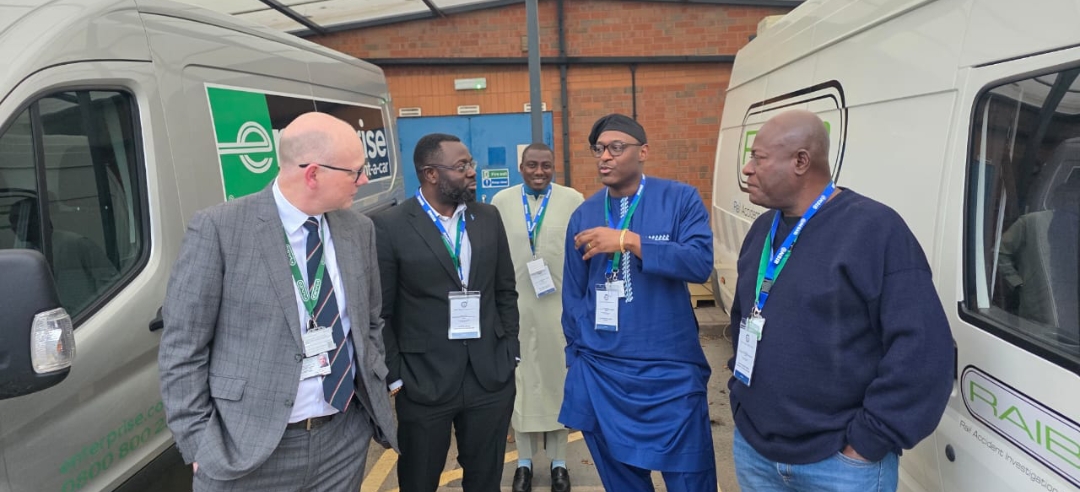
The February 12, 2026, engagement was formally confirmed through official correspondence from RAIB’s Derby Operational Centre, signalling the institutional significance attached to the visit by the UK authority. Designed as a structured peer-review and strategic capacity-building exercise, the programme moved beyond diplomatic courtesy into substantive technical exchange. It provided an opportunity for Nigeria’s rail investigators to interrogate systems, benchmark operational methodologies, and examine tested investigative models adaptable to Nigeria’s expanding rail ecosystem.
Building on these operational methodologies, discussions extended to quality assurance systems, digital case management structures, investigator competency frameworks, and structured training collaborations. Exposure to RAIB’s specialised facilities and investigative technologies offered practical insight into building a resilient, technology-enabled investigative architecture capable of keeping pace with Nigeria’s rail modernisation drive.
The choice of RAIB as a benchmark is highly strategic. Established by the UK government through the Railways and Transport Safety Act 2003, the Branch is among the world’s foremost independent accident investigation authorities. It operates with the singular objective of improving safety systemically, rather than assigning blame.
For NSIB, the engagement comes at a defining moment. The NSIB Act 2022 expanded the Bureau’s mandate beyond aviation to cover rail, marine, and other transportation modes, positioning it as a fully multimodal safety investigation authority. Under Captain Badeh Jr.’s leadership, the Bureau has prioritised operational autonomy, technical sophistication, and data-driven safety intelligence as core reform pillars. The Derby mission directly reinforces this transformation agenda by aligning Nigeria’s processes with a globally respected investigative body.
As Nigeria continues to expand its intercity rail corridors and urban transit systems, the integrity of its safety oversight mechanisms becomes increasingly consequential.
Strengthening investigative capability is not merely reactive; it is preventive. Robust, independent investigations generate actionable safety intelligence that informs regulatory refinement, operational improvements, and long-term risk mitigation strategies.
Recognising this, there is, of course, much work yet to be done by the NSIB. Building a world-class rail accident investigation unit requires sustained investment – in people, equipment, systems, and the institutional culture of rigour and independence that makes investigation findings credible. Recommendations must be acted upon by the relevant authorities; investigative findings must be made publicly accessible; and the Rail Accident Investigation Unit must be staffed and equipped to respond rapidly and professionally when incidents occur.
The significance of this groundwork extends well beyond Nigeria’s borders. Across the African continent, the expansion of rail infrastructure is proceeding at a pace that outstrips institutional capacity in many countries. New rail lines are being commissioned from East Africa to West Africa, often backed by foreign investment and constructed by international contractors, but the domestic regulatory and investigative frameworks to oversee them remain, in many cases, nascent.
Nigeria, as Africa’s largest economy and most populous nation, has both the opportunity and the obligation to lead by example. A credible, internationally benchmarked NSIB Rail Accident Investigation Unit would send a powerful signal, not just to Nigerians, but to the continent, about what is possible when a nation’s safety institutions are led with ambition and governed with integrity.
The NSIB–RAIB synergy, therefore, carries both symbolic and structural weight. It underscores Nigeria’s willingness to benchmark itself against global best practice while reinforcing public confidence in the country’s transportation safety institutions. For industry stakeholders, policymakers, and passengers alike, it signals a maturing safety ecosystem committed to transparency, professionalism, and continuous improvement.
Industry observers who have tracked the NSIB’s recent trajectory note a palpable shift in institutional confidence. “What you are seeing with NSIB is an institution that has decided to take its multimodal mandate seriously,” one transport safety analyst observed. “The RAIB visit is not a standalone event; it is part of a deliberate capacity-building arc that reflects serious institutional thinking.”
Under Captain Alex Badeh Jr’s stewardship, NSIB is charting a clear path toward institutional excellence, one anchored in global collaboration, structured capacity development, and proactive safety leadership. As Nigeria’s rail infrastructure grows in scale and strategic importance, the strengthening of its accident investigation capability will remain fundamental to protecting lives, safeguarding investments, and sustaining trust in the nation’s transportation future.
Cover Photo Caption: Engr. Andy Lewis, Deputy Chief Inspector, Rail Accident Investigation Branch (RAIB); Capt. Martins Avaan, Technical Adviser to the DG, Nigerian Safety Investigation Bureau (NSIB); Engr. Sadiq Abubakar, Safety Investigator, NSIB; Capt. Alex Badeh Jr, Director-General/CEO, NSIB; and Engr. Patrick Nwobu, Director, Technical Services, NSIB, during the Bureau’s technical visit to RAIB’s Operational Centre in Derby, United Kingdom.