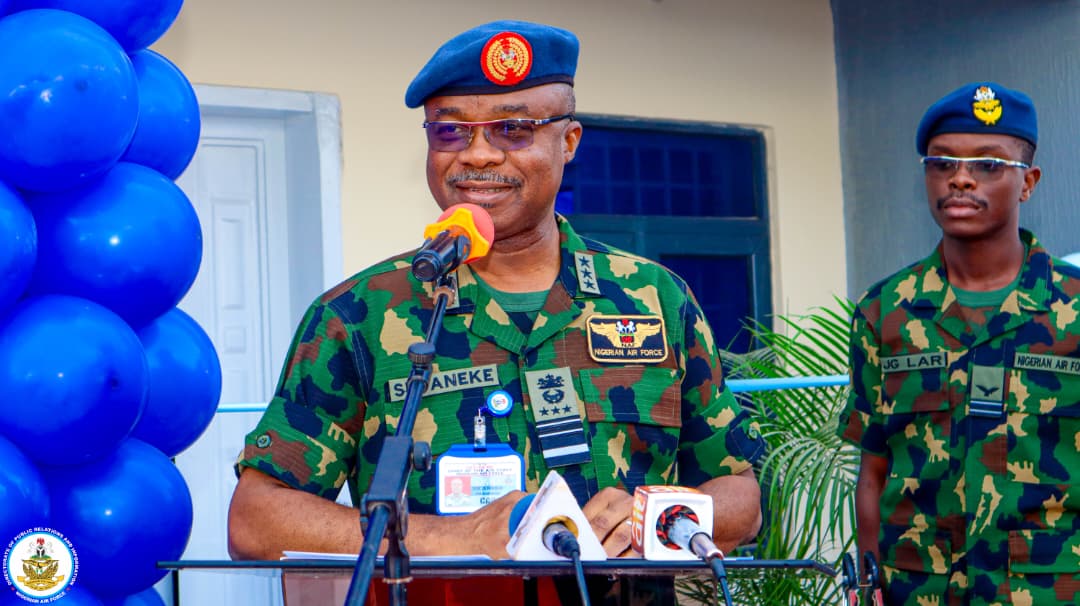
NAF Records Strategic Gains in First 100 Days Under Air Marshal S.K. Aneke
Oru Leonard
The Nigerian Air Force (NAF), has recorded notable operational and institutional gains within the first 100 days of leadership under the Chief of the Air Staff (CAS), Air Marshal Sunday Kelvin Aneke. The milestone period reflects a focused and deliberate effort to reposition the Service for enhanced combat effectiveness, improved accountability, and long-term strategic impact.
Since assuming office, Air Marshal Aneke has prioritized strengthening the NAF’s warfighting capability while consolidating reforms aimed at building a smarter, more agile Air Force. His leadership approach—anchored on clarity of mission, disciplined execution, and measurable outcomes—has translated into tangible improvements across operational, technical, and personnel domains.
Enhanced Combat Readiness and Operational Tempo
A major highlight of the first 100 days is the improvement in aircraft serviceability and availability rates. Through intensified maintenance schedules, strengthened logistics coordination, and closer oversight of fleet management systems, the NAF has significantly enhanced its readiness posture.
The result is an expanded tempo of air operations across various theatres, providing sustained air support to joint and combined security missions nationwide.
By aligning air power deployment more closely with national security priorities, the Service has optimized the use of its platforms for intelligence, surveillance, reconnaissance (ISR), precision strikes, and close air support. This operational recalibration underscores a renewed focus on mission-driven efficiency and rapid response capability.
Targeted Infrastructure and Capability Upgrades
In addition to frontline operations, the NAF has embarked on targeted infrastructure upgrades designed to support sustained air power projection. Improvements to air bases, maintenance facilities, and operational support structures have enhanced turnaround times and increased operational reliability.
These infrastructure efforts are not merely cosmetic upgrades; they are strategic investments aimed at ensuring long-term sustainability. By strengthening mission support systems, the Service is better positioned to maintain operational superiority while reducing downtime and logistical bottlenecks.
Personnel Welfare and Institutional Reform
Recognizing that air power is fundamentally driven by skilled and motivated personnel, Air Marshal Aneke has also placed emphasis on welfare initiatives and human capital development. Within the period under review, the NAF has advanced initiatives focused on accommodation improvements, enhanced healthcare access, and professional development opportunities for officers and airmen.
Training standards have also been reinforced to ensure alignment with evolving operational realities.
Increased emphasis on mission-oriented drills, joint exercises, and technical proficiency underscores a broader commitment to preparedness and adaptability.
Institutionally, renewed emphasis has been placed on accountability frameworks and performance monitoring mechanisms. This approach seeks to embed a culture of transparency and results-based management within the Service—an essential pillar in building public confidence and sustaining operational credibility.
A Coordinated Vision for Strategic Air Power
The gains recorded within the first 100 days are not isolated achievements. Rather, they represent components of a coordinated reform agenda aimed at harmonizing operational capability with institutional resilience. The trajectory suggests a methodical effort to transform the NAF into a more responsive and technologically adaptive force capable of addressing complex security challenges.
Observers note that the disciplined pace of reforms—combined with measurable outputs—signals a leadership style focused less on rhetoric and more on structured execution. The integration of operational improvements with personnel welfare and infrastructure development reflects a holistic approach to force modernization.
Laying the Foundation for Sustained Transformation
While 100 days is a relatively short period in the lifecycle of a military institution, the early indicators under Air Marshal Aneke’s tenure suggest a firm foundation for sustained transformation. Enhanced readiness levels, expanded operational engagements, and strengthened support systems collectively point toward an Air Force consolidating its role as a decisive instrument of national defense.
As the Nigerian Air Force continues to evolve in response to dynamic security demands, the first 100 days under Air Marshal Sunday Kelvin Aneke mark a disciplined and results-driven start. The momentum generated within this period provides a strategic springboard for deeper reforms, enhanced operational dominance, and long-term institutional growth.
Source: NAF Media